
# Top 9 Essential Safety Features to Look for in a Car Parking Lift
As urban spaces shrink and property values soar, commercial developers, property managers, and luxury residential builders are increasingly turning to car parking lifts (also known as car stackers) to double their parking capacity.
However, when you are suspending a two-ton vehicle directly over another high-value asset, one question takes absolute priority over aesthetics, lifting speed, or price: **Is it safe?**
A high-quality mechanical parking garage system should never rely on a single safety component. Instead, it must utilize a multi-layered, redundant safety network designed to mitigate mechanical, hydraulic, and electrical risks.
Based on the industrial-grade engineering of professional Two-Post Parking Lifts (such as the TPP series), here are the 9 critical safety features you must look for before signing a purchasing agreement.
—
### 1. Mechanical Anti-Falling Safety Lock (Every 100mm)
The absolute backbone of car stacker safety is the mechanical lock. You should never buy a lift that relies solely on hydraulic pressure to hold a vehicle in the air over long periods.
Professional TPP models feature heavy-duty mechanical anti-falling safety locks integrated directly into the posts at precise intervals (typically every 100mm). Once the carriage reaches the desired height, it mechanical drops into these locks. Even in the highly improbable event of a total hydraulic pressure loss, the platform remains physically locked in place, incapable of dropping.
### 2. Photocell Sensor (Under-Car Detection)
Human error is one of the most common causes of parking lift accidents—such as attempting to lower a platform when a vehicle or a person is still parked underneath.
To eliminate this risk, advanced car parking systems are equipped with active photocell sensors installed at the base of the posts. This sensor projects an invisible infrared beam across the lower parking bay. If the beam is interrupted by a car, a pedestrian, or even a forgotten box, the entire system instantly immobilizes, preventing any downward movement until the area is completely clear.
### 3. Limit Switch Installed at the Top of the Post
What happens if an operator keeps holding the “UP” button? Without a physical cutoff, the carriage could over-travel, leading to structural damage or a catastrophic accident.
A top-mounted limit switch acts as a foolproof physical circuit breaker. The moment the lifting carriage moves up and touches this switch, power to the motor is instantaneously cut off, stopping the lift safely at its maximum engineered height limit.
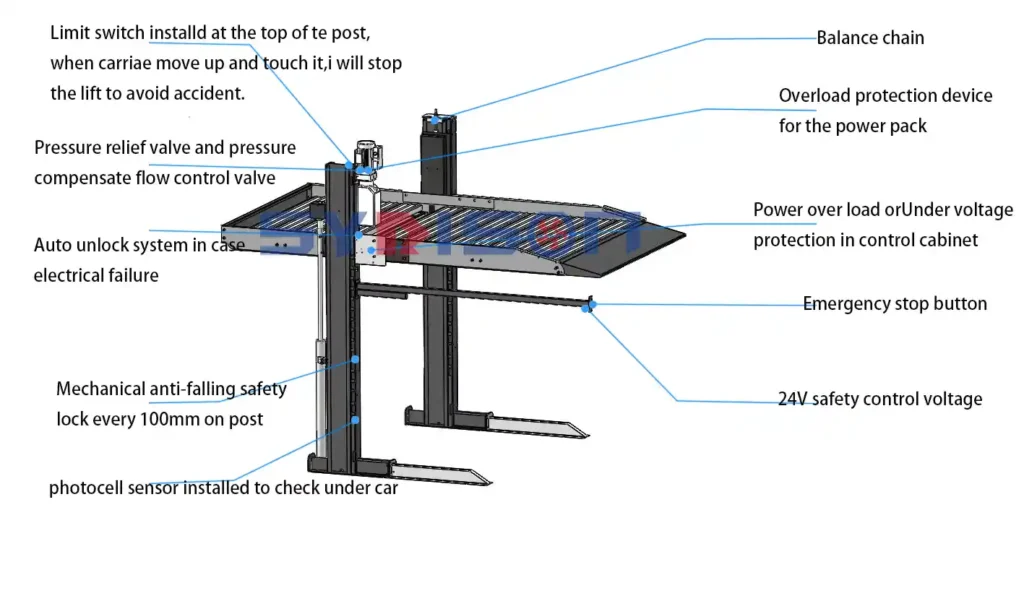
*Caption: Technical blueprint illustrating the multi-layered mechanical, hydraulic, and electrical safety features of a premium two-post car parking lift (TPP series).*
### 4. Pressure Relief Valve & Pressure Compensate Flow Control Valve
The hydraulic power unit is the heart of a car parking lift, and controlling fluid dynamics is vital for operational stability.
* **Pressure Relief Valve:** This valve prevents the system from lifting loads that exceed its rated capacity. If a vehicle is too heavy, the valve opens to bypass hydraulic fluid back into the reservoir, protecting the structure from structural overload.
* **Pressure Compensate Flow Control Valve:** This component regulates the lowering speed. It ensures that the platform descends at a smooth, constant, and controlled velocity, regardless of whether the platform is carrying a heavy SUV or sitting completely empty.
### 5. Balance Chain System
For two-post car parking lifts, keeping the lifting platform perfectly level during ascent and descent is crucial to prevent the vehicle from tilting or slipping. A synchronized balance chain system connects the lifting mechanisms across both posts, ensuring that both sides of the platform move in perfect harmony, keeping the vehicle completely level at all times.
### 6. Overload Protection Device for the Power Pack
Continuous operation or unexpected resistance can cause hydraulic motors to overheat. An integrated overload protection device monitors the electrical current and temperature of the hydraulic power pack. If the system detects abnormal heat or current draw, it temporarily shuts down the motor to prevent terminal damage or electrical fires.
### 7. Power Overload or Under-Voltage Protection in Control Cabinet
Fluctuations in municipal electrical grids can wreak havoc on industrial machinery. Premium car parking systems house advanced electrical protection inside a sealed control cabinet. This includes both overload and under-voltage protection, which shields the lift’s sensitive control components from voltage drops, spikes, or short circuits.
### 8. Emergency Stop Button
In any unpredictable situation, the operator needs immediate, absolute control. Every control arm or station must feature a highly visible, easily accessible, mushroom-head Emergency Stop Button. Pressing this button physically cuts all control power instantly, freezing all moving parts of the car stacker mid-motion.
### 9. 24V Safety Control Voltage
Water, outdoor dampness, or accidental wire wear can pose electrical shock hazards if a system runs high-voltage wiring directly to the user-facing control buttons. To guarantee operator safety, professional systems step down the control panel voltage to a harmless 24V safety control voltage. Even if the control cable is physically compromised, there is zero risk of high-voltage shock to the user.
—
### Conclusion: Making the Safe Choice for Your Project
When investing in a mechanical parking system, cutting corners on safety features to save a fraction of the initial cost is a high-risk gamble. A certified, multi-layered safety infrastructure not only protects millions of dollars worth of automotive assets, but it also reduces your long-term liability, minimizes maintenance downtime, and provides peace of mind for the end-users.
Whether you are designing a commercial residential garage or upgrading a private villa workshop, always demand a detailed safety blueprint.
**Looking for a certified, heavy-duty car parking lift engineered to the highest global safety standards?** [Contact our engineering team today] to get technical specifications and a customized layout for your project.